Drosera dielsianaMost Drosera dielsiana in cultivation should actually be labeled as Drosera natalensis. Unfortunately, it seems there are few true Drosera dielsiana in cultivation. However, you should be able to treat your "Drosera dielsiana" the same as you would Drosera natalensis, so click the link here to be directed to the updated page about Drosera natalensis.To diagnose whether or not you have D. natalensis, seeds can provide a good diagnosis. Additionally helpful discussion on cpukforum.com about the true identity of D. dielsiana |
|
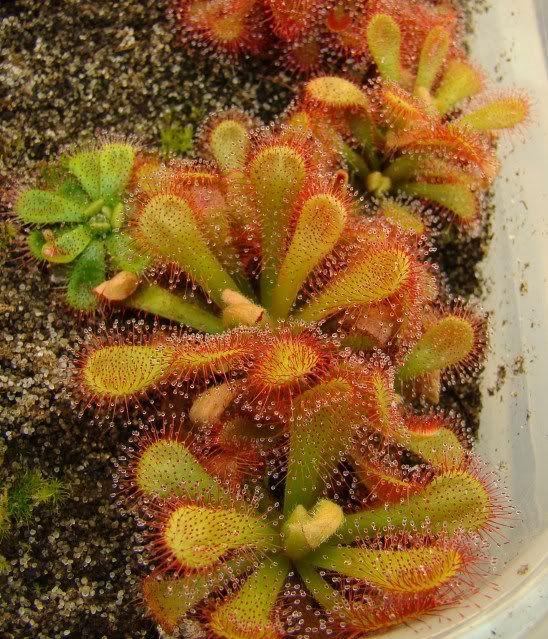
| Drosera natalensis photos (use as a comparison to your "D. dielsiana" 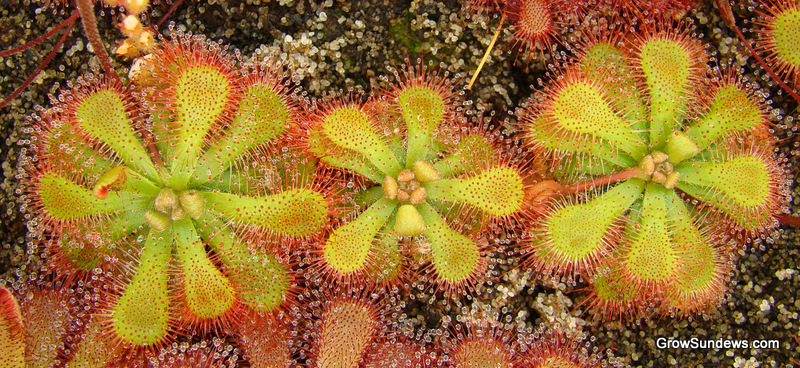 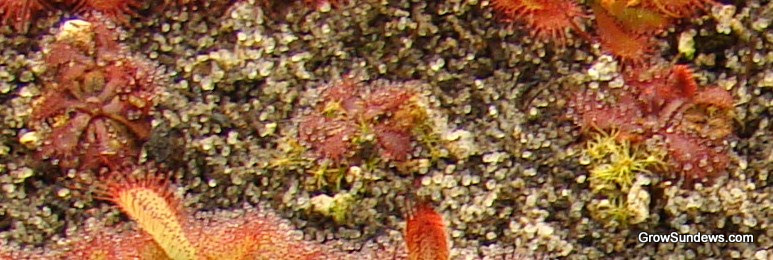 D.
natalensis before being fed every 2
weeks
D.
natalensis before being fed every 2
weeks for a total of 2 months. The plants stayed at this size for 6 months before I decided to feed them. Once fed, they began rapid growth D.
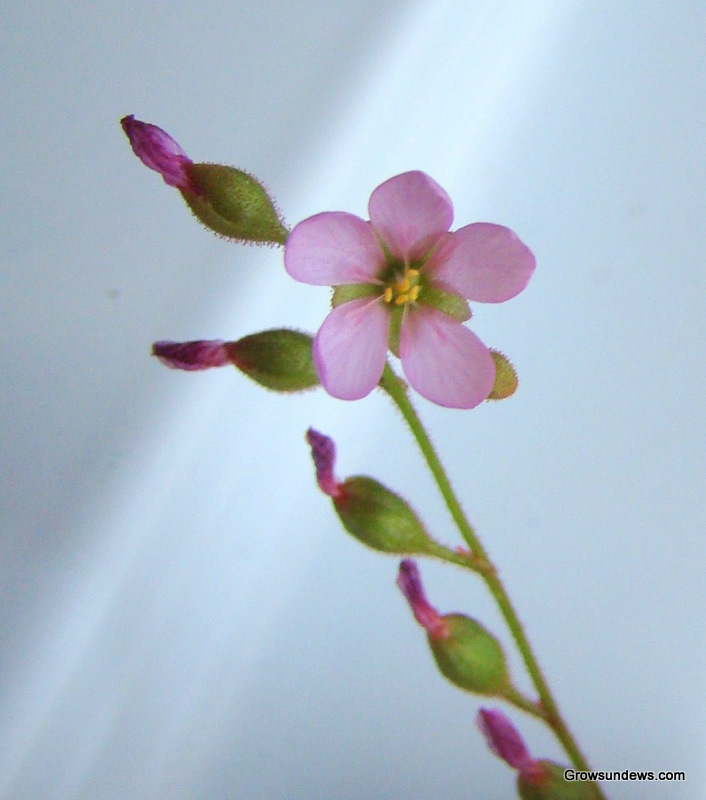
natalensis flower
|
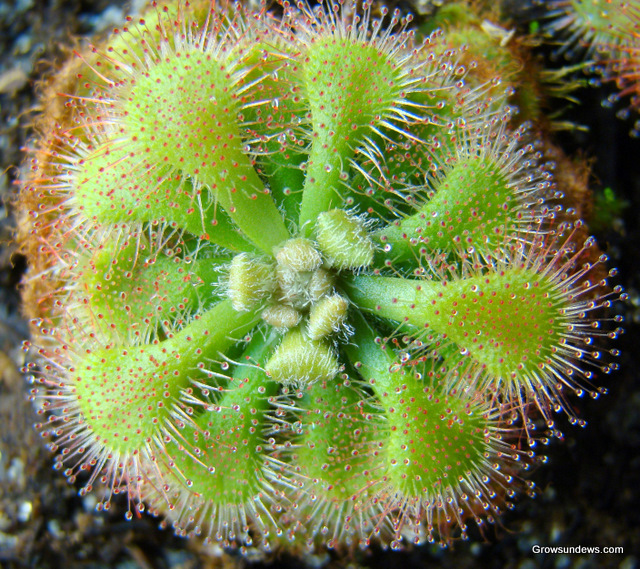
Media: 1:1 peat: sand (silica) is best. Small amounts of perlite can be added. Media moisture: keep moist. isn't picky. Humidity: very little is needed. Pot height: 3 inches or taller. Not picky. Trapping speed: moderate. Leaves will curl around prey within a few hours. Feeding: If fed every 2 weeks, grows extremly rapidly. See feeding page. Feeding also encourages flowering Check out the 2 month photo documentation I made of D. dielsiana when fed over 2 months. Food size: medium to large. Plant dimensions: generally more compact than many other rosetted South African sundews. The form I grow gets around 1-1.5 inches across at maturity. Temperature: D. natalensis can handle a range of 55-90+F with ease. Lighting/Photoperiod: Not picky at all. D. dielsiana should develop bright red coloration if grown under strong light. If fed and is growing quickly, leaves will have a yellow-green hue with bright red tentacles. Dormancy requirements: None. Can be grown year-round if given warm enough temps. If subjected to frost, will die down and come back from roots when temperatures are favorable again. Flowers: D. dielsiana should produce tons of flower stalks and ample amounts of seed. Generally, the stalk is more slender than most South African sundews. Self-pollinates. Flowers are fairly small and pink. Propagation TechniquesSeed: Diagnostic: true Drosera dielsiana seeds are round in shape, with a honeycomb texture on the seed coat. This can be used to identify whether or not you have Drosera natalensis. Leaf-cuttings: have not tried this. Root cuttings: very easy. Divisions: may form clumps over time. Drosera dielsiana should have no trouble dealing with repotting and root disturbance, so divisions can be taken easily. |
Additional Questions or Suggestions?
Contact me at: sundewman(at)yahoo.com